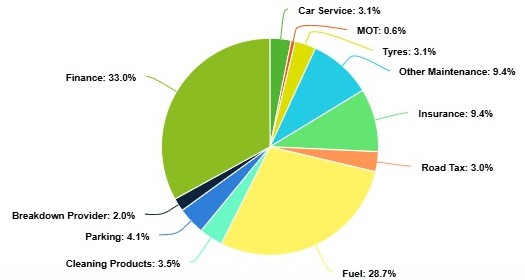
Our recent analysis showed that the average UK driver is likely to spend more than £6,000 on their vehicle this year.
While many of us would expect the price of fuel to be to blame, petrol and diesel costs make up less than ¼ of that!
That means you don’t need to drastically cut your fuel spend; understanding why car ownership feels so expensive in the first place can really help.
Because what you really want to know is where you’re spending money when it comes to your car.
Page Contents
How Much Does the Average Driver Spend on Their Car?
-
£200 a year on a service
-
£38 a year on an MOT
-
£200 a year on tyres
-
£600 on other maintenance & repairs
-
£600 a year on car insurance
-
£190 a year on road tax
-
£1,826 a year on fuel
-
£225 a year on cleaning products
-
£260 a year on parking
-
£125 a year on their breakdown provider
-
£2,100 a year on finance
What Costs Don’t Feel Like Running Costs – But are?
If you were asked what count as vehicle running costs, would you likely answer insurance, road tax or the annual MOT?
Because human brains are designed to mentally compartmentalise individual costs, it’s likely that you wouldn’t. If something is paid infrequently, we’re more likely to consider it mentally ‘finished’.
And that can make it very easy to misjudge totals and focus only on the smaller, monthly expenses like fuel or parking.
Is That Why Fuel Feels Like the Dominant Factor?
Yes, filling up your fuel tank seems like the dominant cost when it comes to your car’s running costs because it’s a constant reminder of how expensive cars are.
Decades of behavioural economics research show that people tend to focus more on frequent, visible costs, while under-integrating infrequent or fixed expenses – particularly when those costs are spread over different time periods.
In particular, research into mental accounting (a theory first proposed by Richard Thaler in 1999) shows that people don’t naturally think in annual totals. Instead, we mentally separate costs, making it harder to grasp overall spending totals.
That turns ad-hoc re-fuelling into a scapegoat rather than the actual reason our vehicles are so expensive to run.
So, is That Why My Car Feels Randomly Expensive?
Exactly that. Because it’s very easy to moan about how expensive fuel is every time we fill up, it dominates our anxiety – unlike insurance, road tax and vehicle depreciation.
In fact, behavioural economists have shown that we give more weight to costs we see more regularly, such as fuel, parking or ad hoc maintenance, even when they aren’t the biggest part of the bill. This tendency to focus more on the variable costs, known as ‘salience theory’ is why recurring expenses feel larger – it’s simply because we encounter them more often.
Over-exposure to ongoing small costs is exactly why owning a car feels incredibly stressful for most drivers. Predictability matters more to us than price; knowing your MOT is only due once a year and getting it done and dusted makes the cost much easier to stomach than filling up your fuel tank every two weeks.
So, if you’re often feeling like your car is a money pit, you’re not alone. There are many studies that show that people are less likely to actively track yearly costs such as car insurance and vehicle tax – making car ownership feel randomly expensive and incredibly stressful.
How to Think About Your Car’s Costs Differently
Your car doesn’t cost more because of fuel or insurance or servicing or parking – it costs more because our brains aren’t good at adding fragmented costs together.
But that means we need to train our brains to think differently about how much we’re actually spending on our vehicles.
Here are a few ways you can start doing that.
Stop Thinking in Moments – Start Thinking in Totals
Individual payments can be misleading. A £70 fill-up feels expensive at the time, but only because it’s visible and immediate.
Yearly insurance is far more expensive but, if you pay it off in one go, it doesn’t feel anywhere near as painful as the cost of a tank of fuel.
So, while annual totals are unintuitive, focusing on the bigger picture can help you improve your mental accounting and give you a much clearer view of where your money is actually going across the whole year.
Reframe Fuel as a Symptom, Not the Problem
In a recent study, we found that the average driver fills up their car twice a month, making it one of the few car costs you engage with regularly.
Frequency creates the illusion of dominance – but it’s actually just the most emotionally ‘noisy’ cost.
Fuel costs are a big contributor towards our car’s overall running costs, so you’re right to look at saving money where possible while filling up. However, it might not dominate spending in the way you think it does.
Putting less focus on the cost of fuel in relation to your vehicle’s running costs can help you avoid a ‘blinkering’ effect and focus better on the actual big costs.
Recognise Which Costs You Mentally ‘Close’ and Forget
Regular running expenses are easy to remember because you interact with them often – less frequent or annual costs are usually only focused on around the time they’re due.
A one-off annual payment feels completed once done, which is why insurance, road tax or servicing costs often stop registering after you’ve made the payment.
But this doesn’t mean they’re small. It just means they become psychologically invisible to us.
For the costs you usually pay and forget, it’s worth remembering that paid doesn’t equal cheap and forgotten doesn’t equal insignificant; they’re still some of the bigger contributors towards your overall running costs.
Separate Predictable Costs from Salient Ones
Most of us know when our MOT, road tax and insurance are due each year and so know when to expect them. These costs are predictable and ‘quiet’, often not due again for 12 months after being paid off.
It’s much harder to predictable ad-hoc costs like repairs and fuel. These can feel louder and more stressful because they interrupt our lives and make our cars seem randomly expensive.
Just remember that although something feels stressful, it might not actually cost the most – and is worth separating from the predictable, ‘quiet’ costs.
Accept that Your Intuition isn’t Designed for Annual Costs
Most importantly, it’s worth remembering that our brains have evolved to track small, frequent expenses and are poor at aggregating costs spread over time.
Cars are particularly good at exploiting this weakness because their costs are fragmented and often split between ongoing expenses and annual payments.
This means focusing on small, regular costs like fuel or parking isn’t a personal failing; it’s human behaviour.
Accepting that can help you understand why costs racking up can feel so expensive and give you the clarity you need to start budgeting more effectively.
Shift the Question from ‘What Feels Expensive’ to ‘What Adds Up’
Finally, try to remove the emotion from your car’s running costs.
Understanding what expenses actually add up and meaningfully contribute to your vehicle’s running costs, rather than feeling like something is expensive, will help you approach the topic much more logically.
Spending £6,000 a year to keep your car running can be scary and make you question every expense.
However, it’s not because you're bad with money – running costs feel expensive because they arrive in a way our brains struggle to process.
Re-framing how you look at vehicle running costs can go a long way towards making car ownership much less stressful.






No comments yet
Leave a comment